Weather and colour
As the eye would see it — and as later telescopes did
The official visible-light Voyager composite is almost featureless. NASA Science has its own wording about the 1986 flyby. Hubble later photographed a measured dark spot. Webb, in infrared, filled the sky with rings.
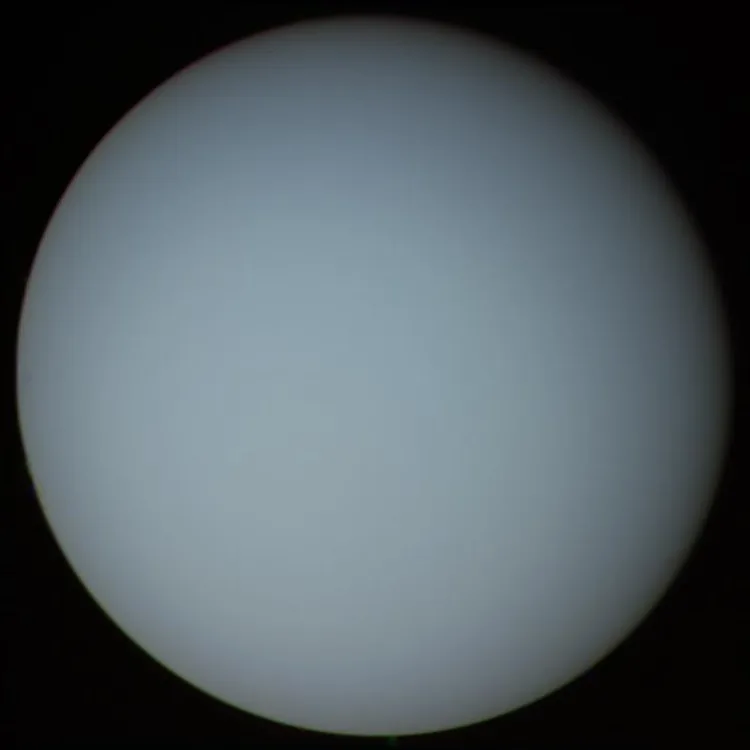
On 17 January 1986, several days from closest approach, Voyager 2 recorded the images compiled into this visible-light portrait, from 9.1 million kilometres. The official caption is the reason this still is on the desk: it has been processed to show Uranus as human eyes would see it from the spacecraft. It is a pale cyan disk, with almost nothing to point at. That is not a failure of the camera. It is what the official label says the eye would have had in front of it.
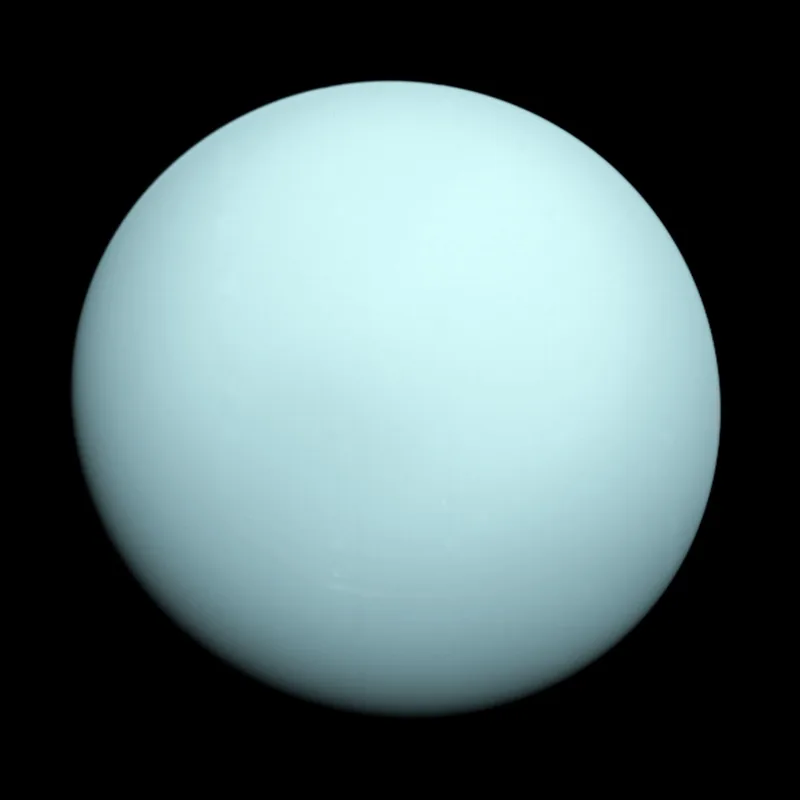
The second Voyager still is a different official file. Its own caption tells you to see Uranus.jpg — the picture above — for how Uranus would appear in visible light. Keeping both is the point. A processed disk and an as-the-eye-would-see-it disk are not interchangeable, even when they come from the same encounter.
NASA Science’s facts page, opened on 18 November 2026, has its own wording about that flyby: “While Voyager 2 saw only a few discrete clouds, a Great Dark Spot, and a small dark spot during its flyby in 1986 — more recent observations reveal that Uranus exhibits dynamic clouds as it approaches equinox, including rapidly changing bright features.” [source] That sentence is quoted here as official public wording. It is not silently rewritten to match the pale visible-light composite, and the composite is not taken down to make the sentence easier.
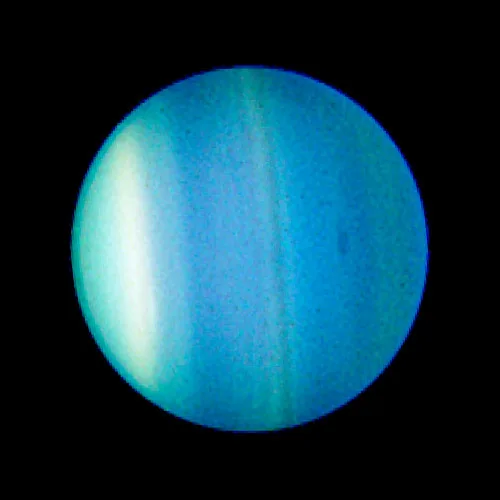
Twenty years later, Hubble recorded a dark spot. The official caption for the 23 August 2006 still gives a vortex 1,100 miles by 1,900 miles, large enough to engulf two-thirds of the United States, caused by churning winds. It is a small picture by modern standards, and a carefully measured official feature. It sits here as a later, dated photograph, not as a replacement for Voyager’s visible-light disk.
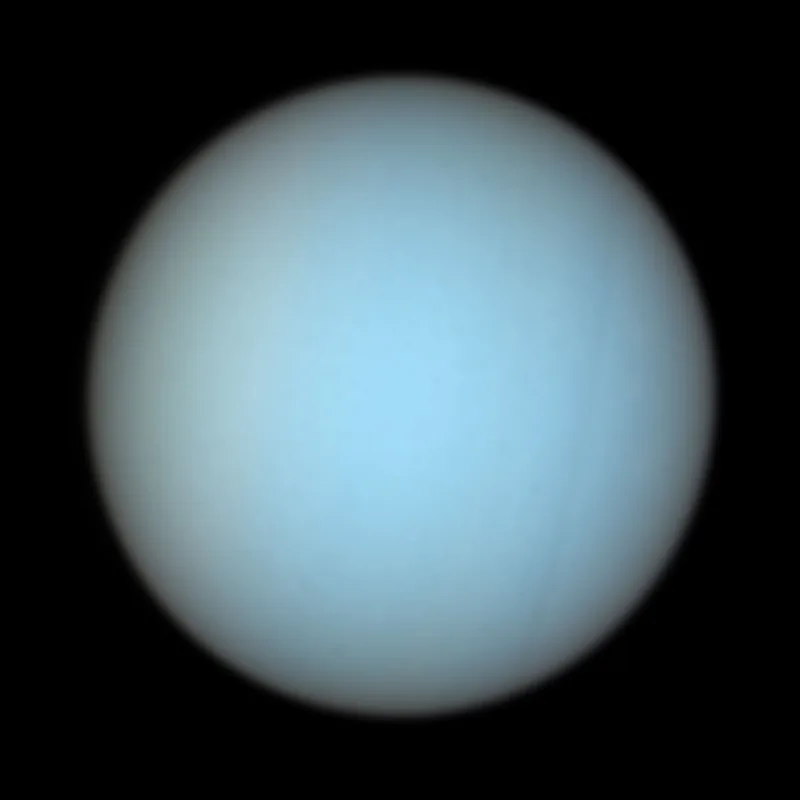
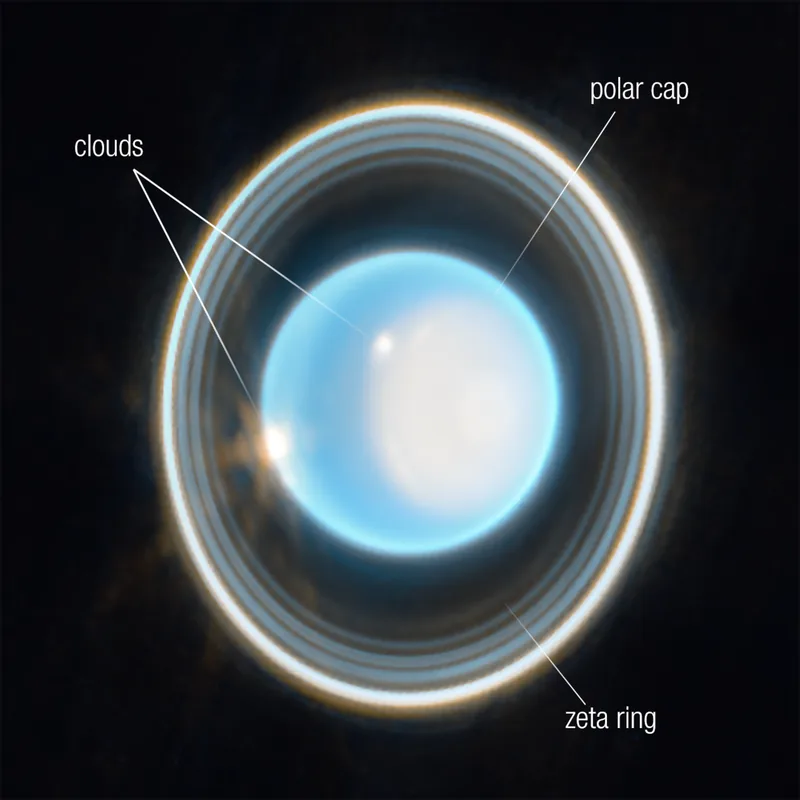
Hubble, in 2002 and 2003, showed faint rings and moons in what the file calls natural colours. Webb, on 6 April 2023, showed dramatic rings in infrared, including dusty rings that, the official caption says, had only ever been imaged by Voyager 2 and Keck. NASA Science says Uranus gets its blue-green colour from methane, which absorbs the red portion of the light. [source] The same page gives a minimum temperature of 49 K (−224.2°C), even colder than Neptune in some places, and wind speeds of up to 560 miles per hour (900 kilometres per hour). The fact sheet lists winds of 0–250 m/s, which is the same 900 km/h in different units, a temperature of 76 K (−197°C) at the 1-bar level and 53 K (−220°C) at 0.1 bar, and an atmosphere of 82.5% molecular hydrogen, 15.2% helium and 2.3% methane. [source]
The sideways seasons that rearrange this weather are on the tilt desk.
Enjoyed a 97.77-degree tilt, a 21-year winter, and a Voyager disk that is not the same as a Webb ring portrait?
No pop-ups. No intrusive advertising. Just interesting stuff. A little support helps the next planets.im site get built.