uranus.planets.im
The first planet found with a telescope rolls on its side — and hid its weather from the eye.
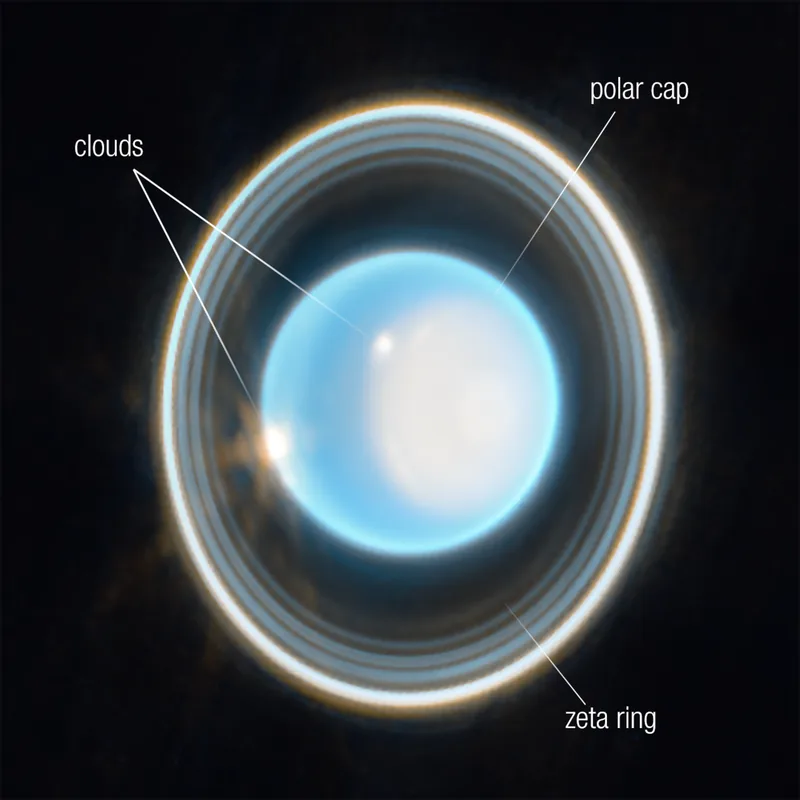
NASA Science and the official fact sheet agree on a tilt of 97.77 degrees. They then differ, slightly, on how many Earth days make a year. Voyager’s visible-light look is a pale disk; Hubble and Webb, later, found rings and weather.
A world that rolls, and a world that hid its weather
NASA Science calls Uranus the seventh planet from the Sun, with the third-largest diameter of the planets, and says it appears to spin sideways. [source] The official fact sheet and that same facts page agree, unusually cleanly, on a tilt of 97.77 degrees. [source] For nearly a quarter of each Uranian year, NASA Science says, the Sun shines directly over each pole, plunging the other half of the planet into a 21-year-long, dark winter.
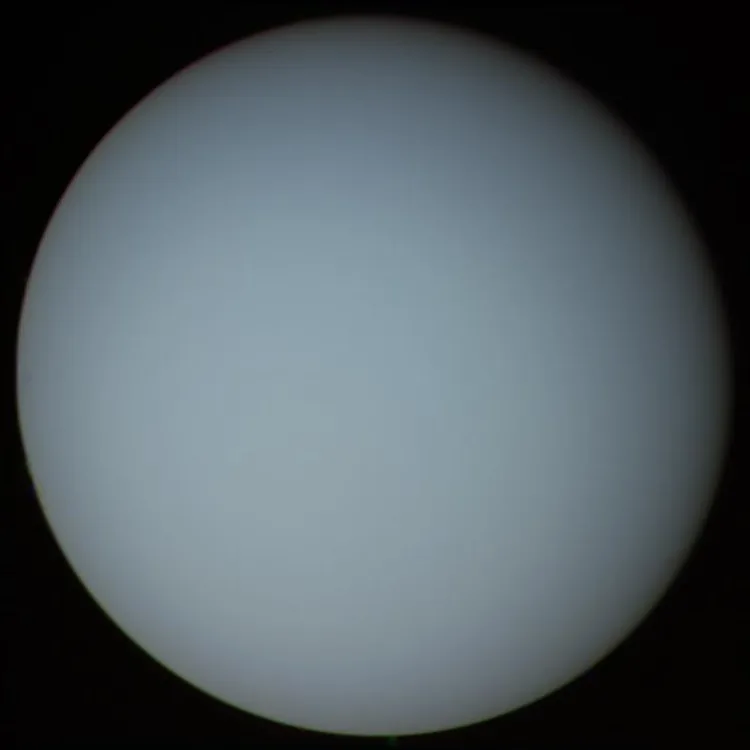
The still above is the official visible-light Voyager 2 composite: processed, the file says, to show Uranus as human eyes would see it, from 9.1 million kilometres on 17 January 1986. It is pale, and almost quiet. The James Webb portrait at the top of this page is infrared, and is full of rings. Both are official. Neither is a reason to throw the other away.
William Herschel found this planet with a telescope on 13 March 1781 — the first planet discovered that way, on NASA Science’s telling — and tried, unsuccessfully, to name it Georgium Sidus after King George III. Johann Bode suggested Uranus, the Greek god of the sky. [source] The fact sheet lists the discoverer as William Herschel and the date as 13 March 1781. [source]
The planet on its side
97.77 degrees, a 21-year polar winter, and two official counts of an 84-year orbit.
A pale disk, and a dark spot
Voyager as the eye would see it, a later Hubble vortex, and NASA Science’s own wording about 1986.
Miranda, and a Shakespearean family
28 moons on both official pages, named for Shakespeare and Pope, and a Voyager mosaic of Miranda.
Myths versus facts
False colour and infrared are labelled. A year of 30,685.400 days is not silently replaced by 30,687.
Enjoyed a 97.77-degree tilt, a 21-year winter, and a Voyager disk that is not the same as a Webb ring portrait?
No pop-ups. No intrusive advertising. Just interesting stuff. A little support helps the next planets.im site get built.