Moons and rings
A Shakespearean family, and a moon called Miranda
Twenty-eight moons, thirteen rings, and a Voyager mosaic of Miranda — with Ariel, Titania and Oberon photographed on the same January day in 1986.
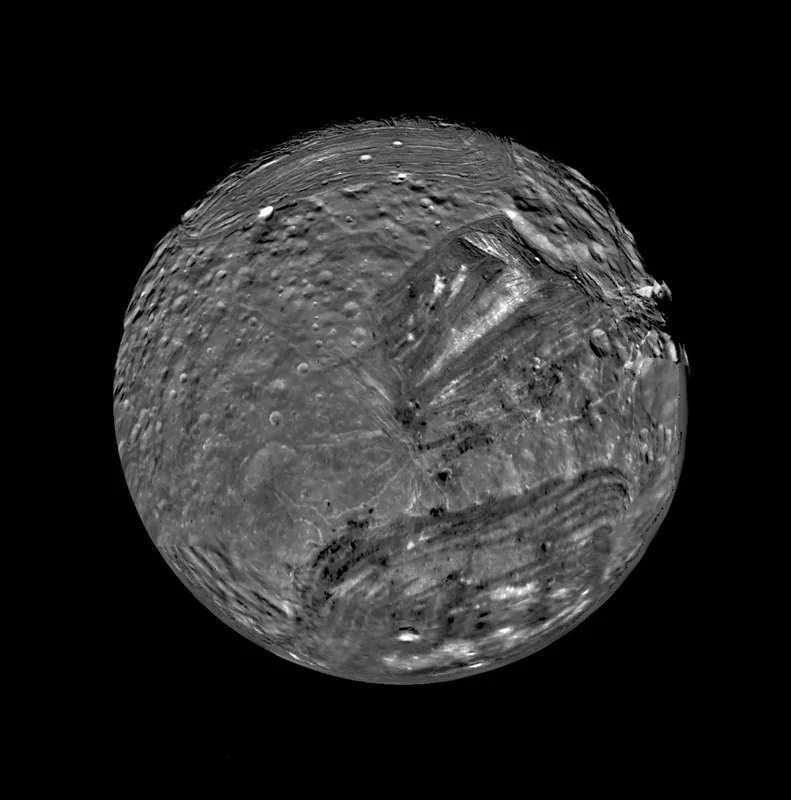
NASA Science says Uranus has 28 known moons, named for characters from the works of William Shakespeare and Alexander Pope, and 13 faint rings — an inner system of nine mostly narrow, dark grey rings, and two outer rings, one reddish and one blue. [source] The fact sheet also lists 28 natural satellites, and a planetary ring system. [source] For once the moon count matches.
Miranda, in this Voyager 2 mosaic from the January 1986 flyby, is the close look. The official file says Miranda was first observed in 1948 by Gerard Peter Kuiper, is named for the daughter of Prospero in The Tempest, and was the fifth satellite of Uranus to be discovered. It is also, of the moons Voyager passed, the one the official caption says could be studied in much greater detail than ever before. The patched, chevroned terrain in the mosaic is why people still stop on this picture.
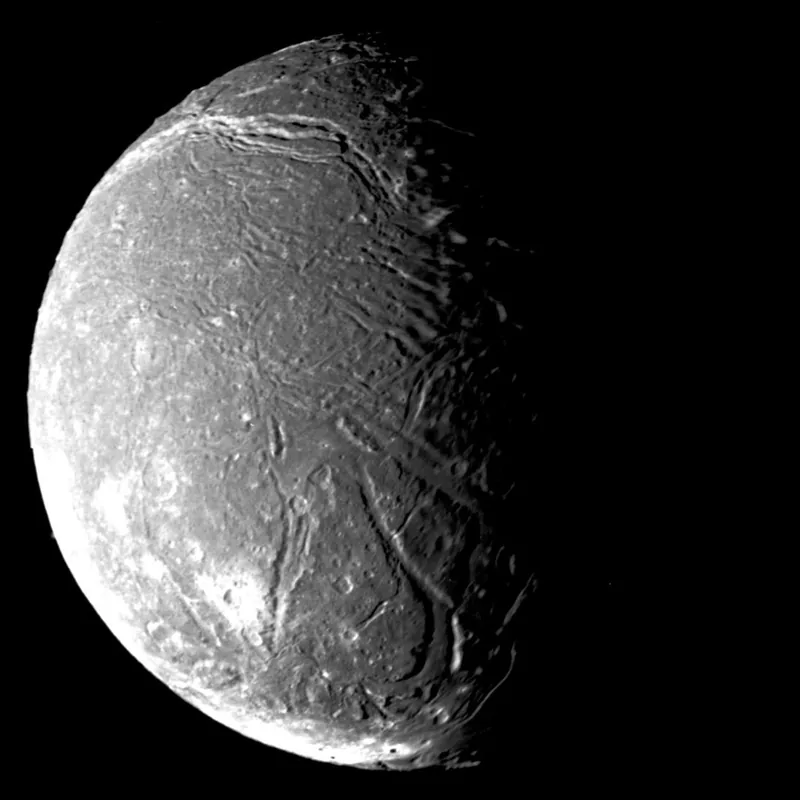
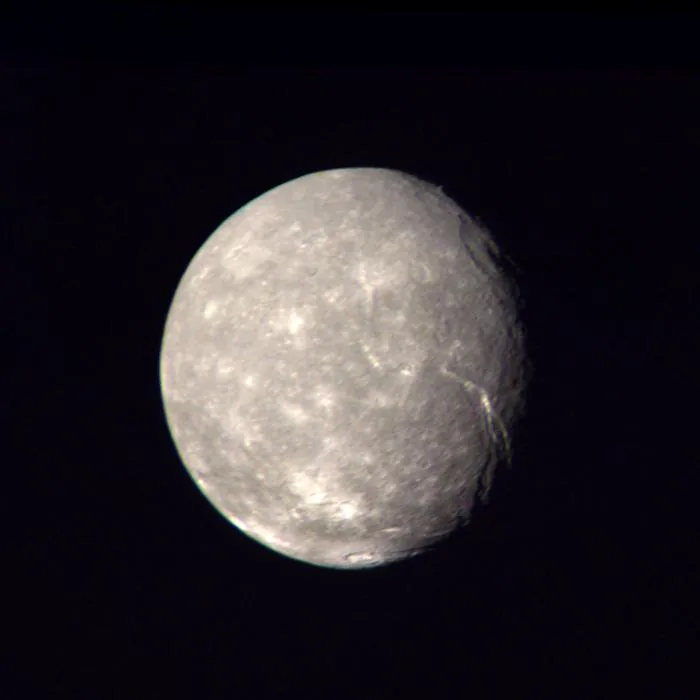
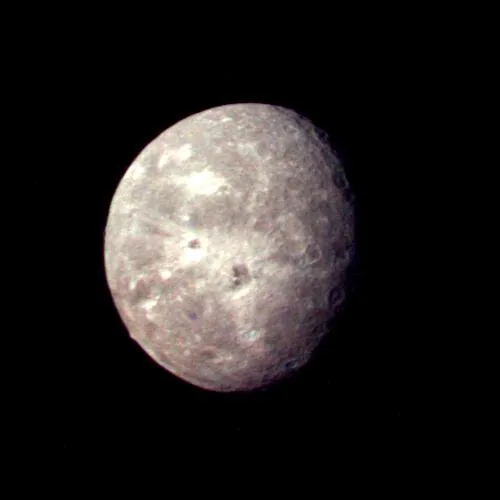
Ariel, on 24 January 1986, in a mosaic the caption calls the most detailed Voyager 2 picture of that satellite. Titania, the same day, as a high-resolution colour composite made as the spacecraft neared closest approach. Oberon, shortly after 3:30 a.m. PST on 24 January 1986, from 660,000 kilometres, in the best picture Voyager acquired of the outermost moon, with the colour reconstructed, as the official caption says.
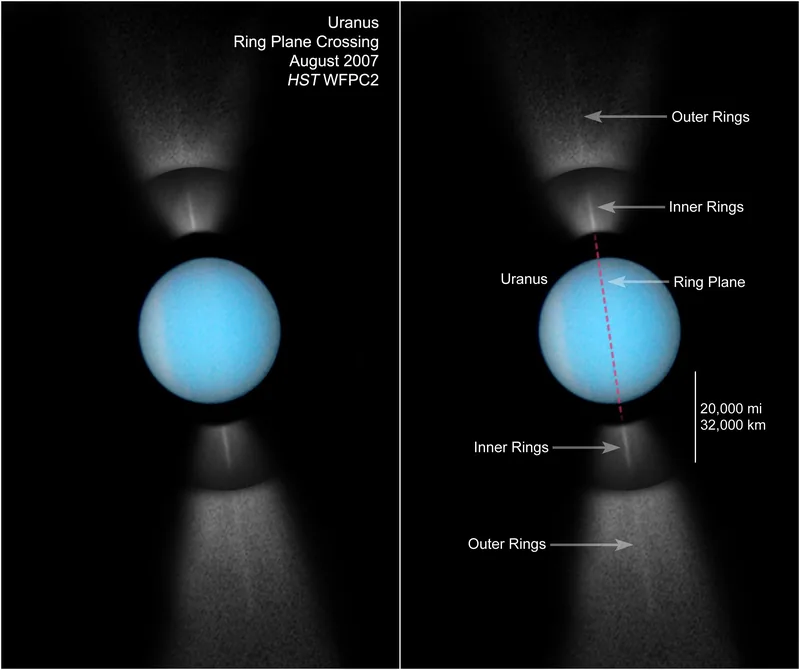
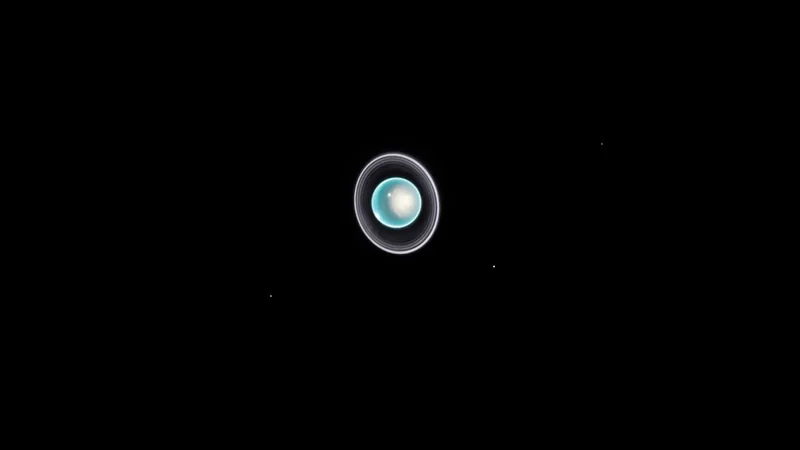
Hubble’s 14 August 2007 still turns the rings into a single edge-on line — a geometry that only a sideways planet offers. The wider Webb view, processed from official NIRCam data by Andrea Luck in August 2023 and released under CC BY 2.0, places Ariel, Miranda and Umbriel in the same frame as the planet. It is a derivative of observatory data, and is credited that way.
NASA Science says most of the inner moons appear to be roughly half water ice and half rock, and that the composition of the outer moons remains unknown, but they are likely captured asteroids. [source] Those are official hedges, and they stay hedges.
Enjoyed a 97.77-degree tilt, a 21-year winter, and a Voyager disk that is not the same as a Webb ring portrait?
No pop-ups. No intrusive advertising. Just interesting stuff. A little support helps the next planets.im site get built.