The same official surprises, with a little more room to stand and look.
A shorter walk, still from official pages.
A planet that rolls
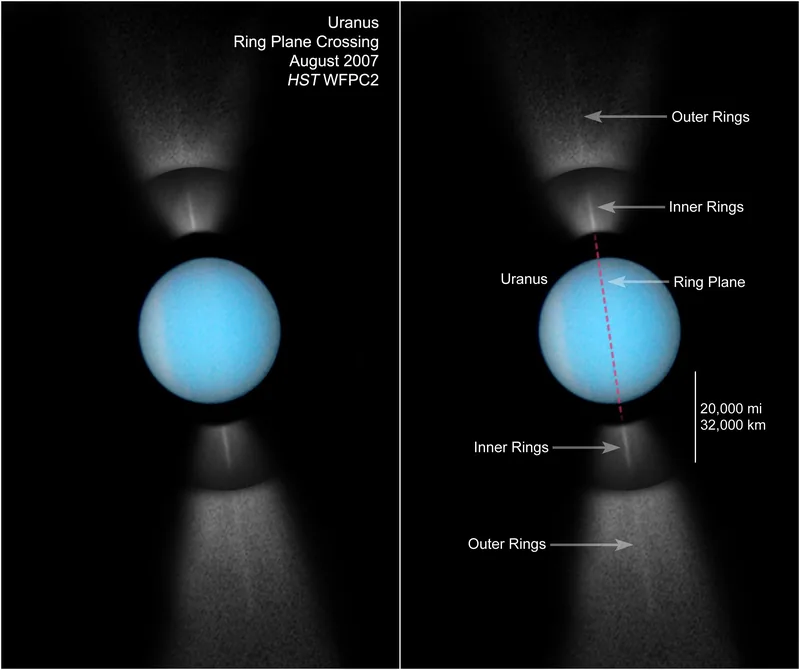
Both official pages give a tilt of 97.77 degrees. NASA Science says Uranus orbits the Sun like a rolling ball, and that a winter at one pole can last 21 years. The tilt desk puts those official clocks in one room.
Hubble’s Wide Field Planetary Camera 2, on 14 August 2007, captures a rare view of the entire ring system of Uranus, tilted edge-on to Earth. A sideways world, showing its rings as a line. Public domain.Photo: NASA, ESA, M. Showalter (SETI Institute) and Z. Levay (STScI) · Public domain · NASA/ESA / Wikimedia Commons
A pale planet, and then a planet with rings
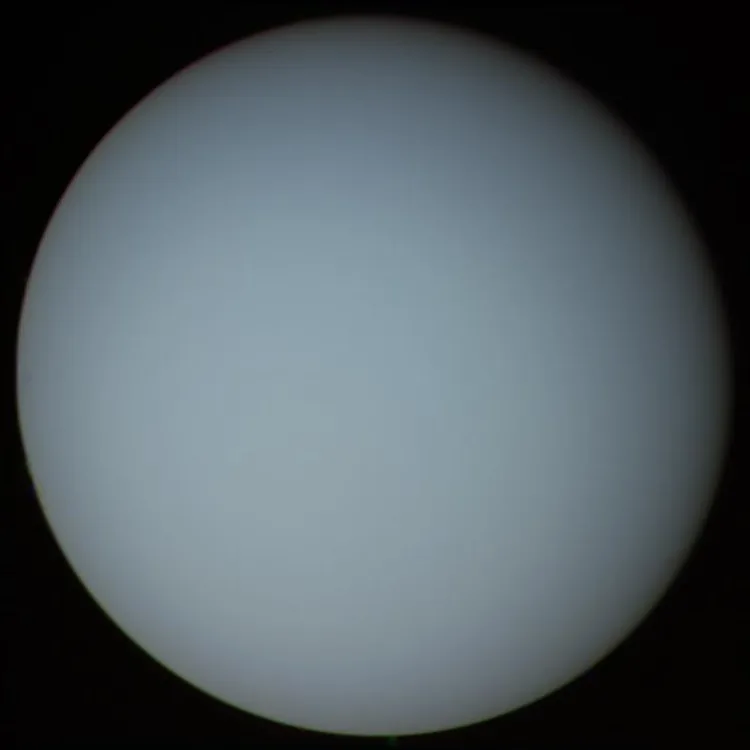
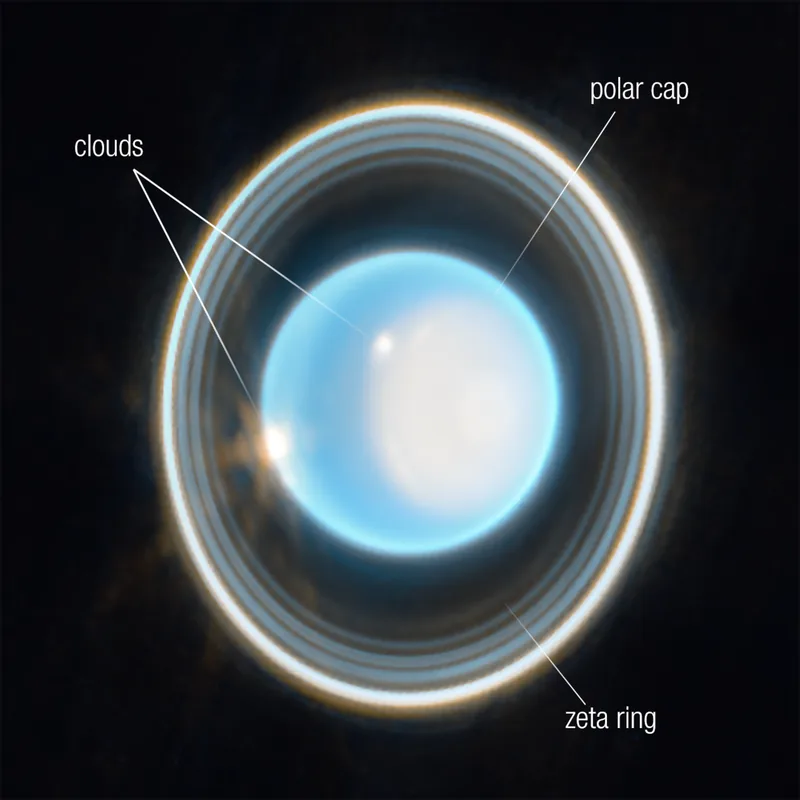
Voyager’s official visible-light look is almost featureless. Webb’s infrared portrait is full of rings. They are both true as labelled. That is a good distinction to practise.
Compiled from Voyager 2 narrow-angle images returned on 17 January 1986, from 9.1 million kilometres (5.7 million miles), several days from closest approach. The official caption says this picture has been processed to show Uranus as human eyes would see it from the vantage point of the spacecraft. Public domain.Photo: NASA / JPL · Public domain · NASA/JPL / Wikimedia CommonsA NIRCam image from the James Webb Space Telescope, dated 6 April 2023, released by NASA, ESA, CSA and STScI. The official caption points to dramatic rings and bright features in the atmosphere, and notes that the faintest dusty rings had previously been imaged only by Voyager 2 in 1986 and by the Keck Observatory. An infrared portrait, not a visible-light postcard. Public domain.Photo: NASA, ESA, CSA, STScI · Public domain · NASA/ESA/CSA/STScI / Wikimedia Commons
A moon with a name from The Tempest
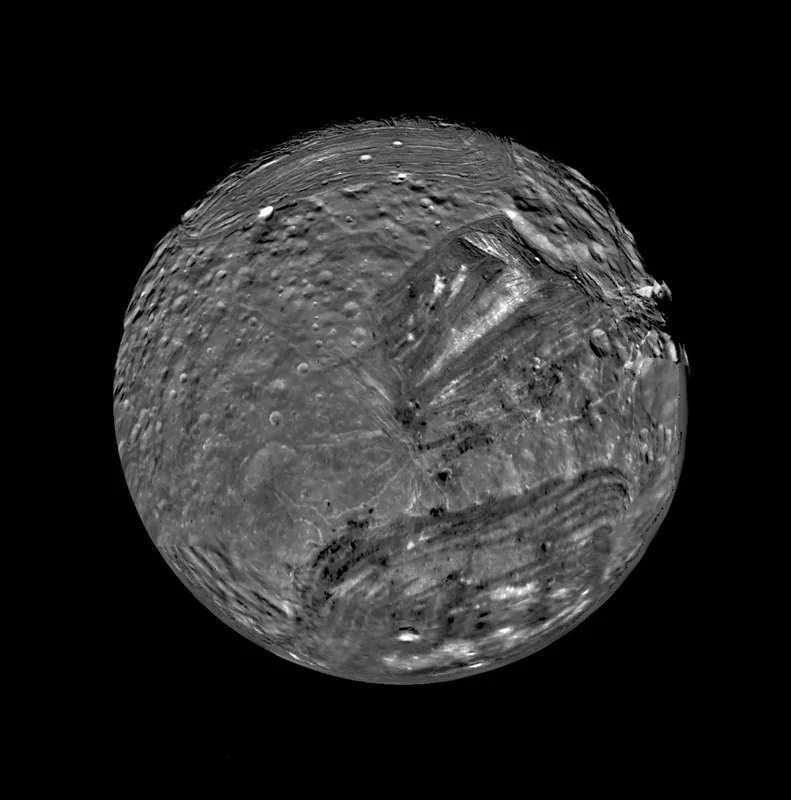
Miranda, in a Voyager mosaic, is named for Prospero’s daughter. The other moons, NASA Science says, come from Shakespeare and Alexander Pope as well. A gentle quiz lives at the quiz.
A Voyager 2 mosaic of Miranda, from the January 1986 flyby. The official file notes that Miranda was first observed in 1948 by Gerard Peter Kuiper, and is named for the daughter of Prospero in Shakespeare’s The Tempest. The fifth satellite of Uranus to be discovered, and the one Voyager saw in the most detail. Public domain.Photo: NASA · Public domain · NASA / Wikimedia CommonsKeep the lights on
Enjoyed a 97.77-degree tilt, a 21-year winter, and a Voyager disk that is not the same as a Webb ring portrait?
No pop-ups. No intrusive advertising. Just interesting stuff. A little support helps the next planets.im site get built.