Credits
Every photograph on this site
Licences were checked on each source page on 18 November 2026. Public-domain NASA and allied stills are used throughout. One still, where used, is CC BY 2.0 and is credited on this page.
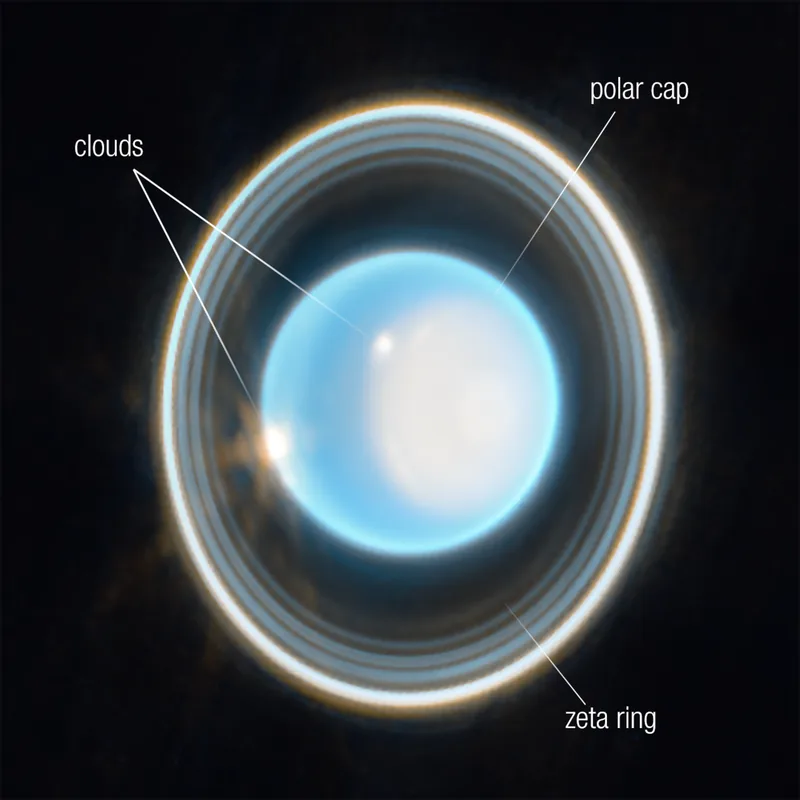
A NIRCam image from the James Webb Space Telescope, dated 6 April 2023, released by NASA, ESA, CSA and STScI. The official caption points to dramatic rings and bright features in the atmosphere, and notes that the faintest dusty rings had previously been imaged only by Voyager 2 in 1986 and by the Keck Observatory. An infrared portrait, not a visible-light postcard. Public domain. Photo: NASA, ESA, CSA, STScI · Public domain · NASA/ESA/CSA/STScI / Wikimedia Commons 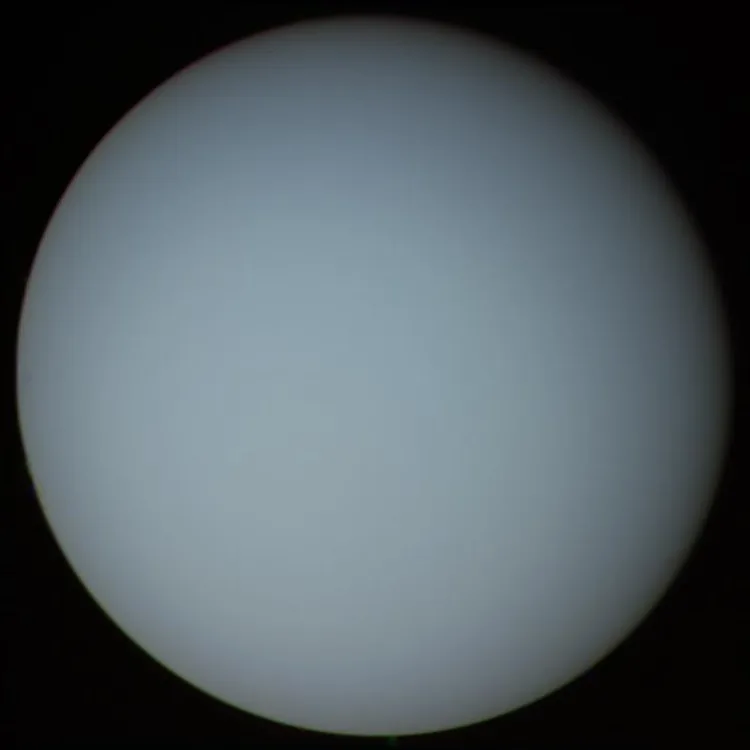
Compiled from Voyager 2 narrow-angle images returned on 17 January 1986, from 9.1 million kilometres (5.7 million miles), several days from closest approach. The official caption says this picture has been processed to show Uranus as human eyes would see it from the vantage point of the spacecraft. Public domain. Photo: NASA / JPL · Public domain · NASA/JPL / Wikimedia Commons 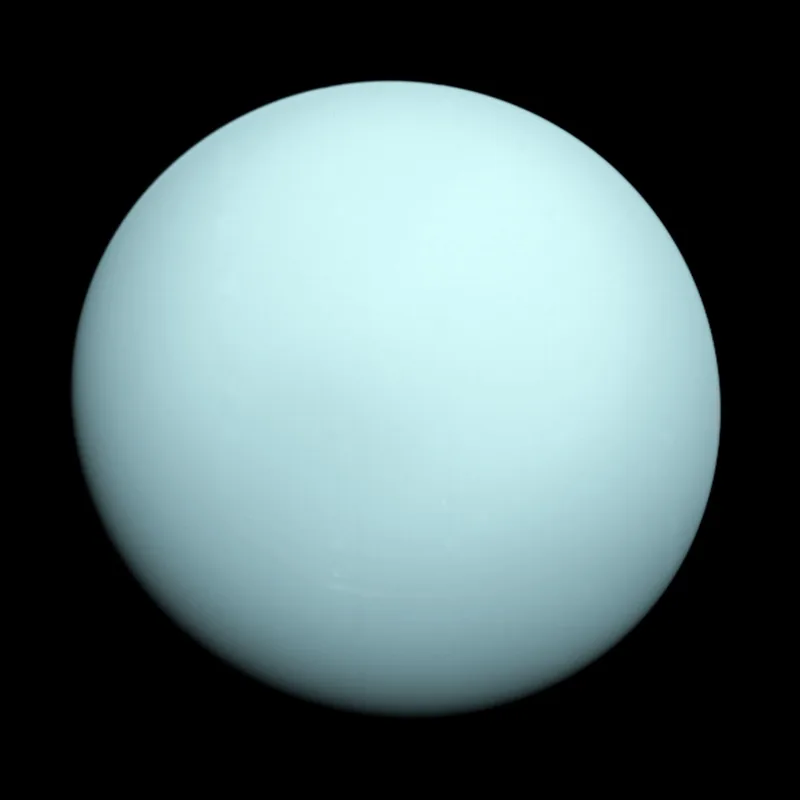
A Voyager 2 image of Uranus from 1986. The file itself says: see Uranus.jpg for how Uranus would appear in visible light. This still is kept here so the two official versions can be compared, not as a substitute for the visible-light composite. Public domain. Photo: NASA / JPL-Caltech · Public domain · NASA/JPL-Caltech / Wikimedia Commons 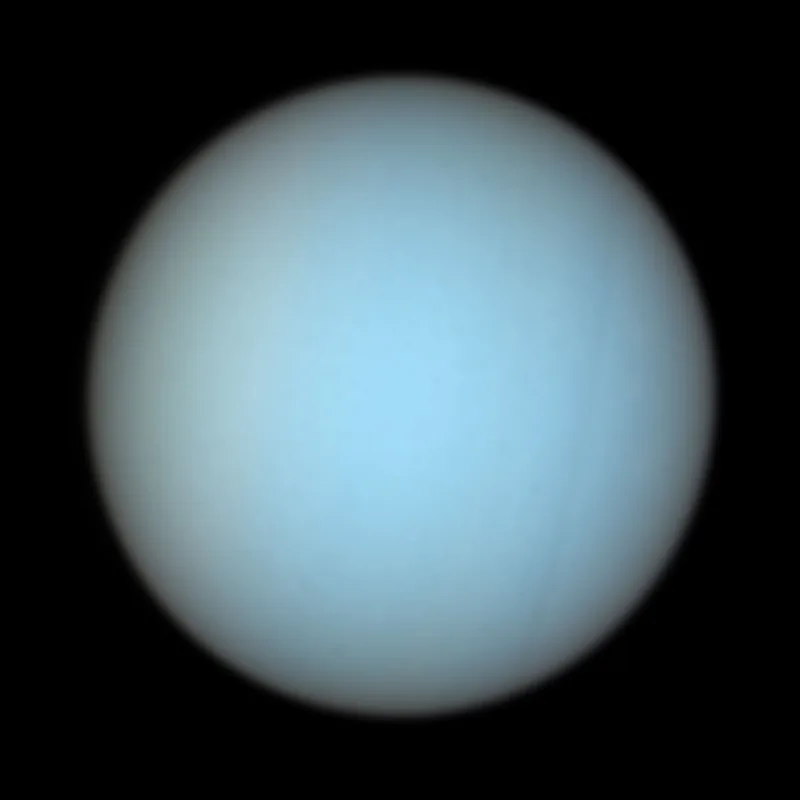
Taken with the Space Telescope Imaging Spectrograph and the Advanced Camera for Surveys on Hubble, in observations dated 19 August 2002 and 30 August 2003. The official description says this image reveals, in natural colours, Uranus’s faint rings and several of its satellites. Public domain. Photo: NASA / ESA and Erich Karkoschka, University of Arizona · Public domain · NASA/ESA / Erich Karkoschka / Wikimedia Commons 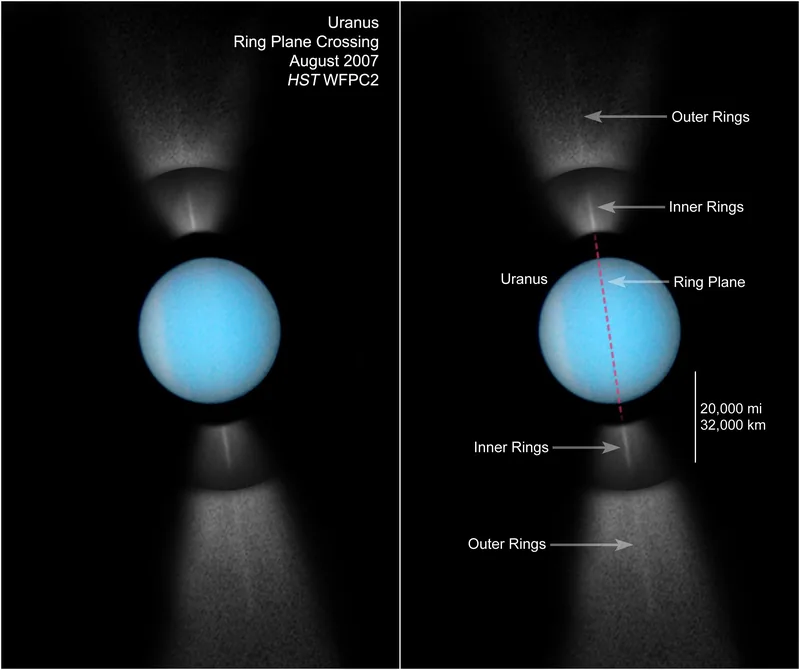
Hubble’s Wide Field Planetary Camera 2, on 14 August 2007, captures a rare view of the entire ring system of Uranus, tilted edge-on to Earth. A sideways world, showing its rings as a line. Public domain. Photo: NASA, ESA, M. Showalter (SETI Institute) and Z. Levay (STScI) · Public domain · NASA/ESA / Wikimedia Commons 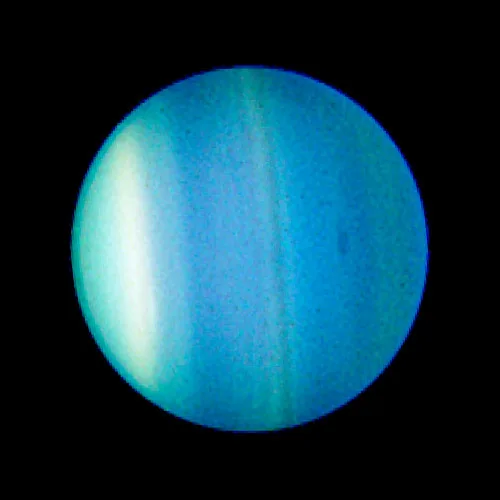
Uranus with a dark spot on the eastern side, in a Hubble still associated with 23 August 2006. The official caption gives the vortex as 1,100 miles by 1,900 miles — large enough to engulf two-thirds of the United States — caused by churning winds. A small official picture, and a carefully measured feature. Public domain. Photo: NASA, ESA, L. Sromovsky and P. Fry (University of Wisconsin), H. Hammel (Space Science Institute), and K. Rages (SETI Institute) · Public domain · NASA/ESA / Wikimedia Commons 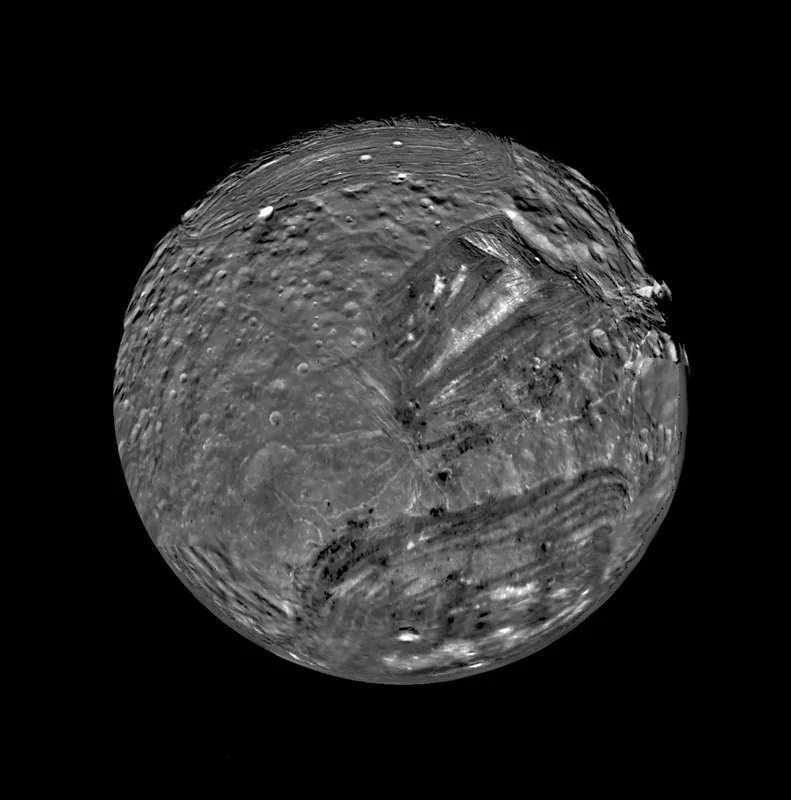
A Voyager 2 mosaic of Miranda, from the January 1986 flyby. The official file notes that Miranda was first observed in 1948 by Gerard Peter Kuiper, and is named for the daughter of Prospero in Shakespeare’s The Tempest. The fifth satellite of Uranus to be discovered, and the one Voyager saw in the most detail. Public domain. Photo: NASA · Public domain · NASA / Wikimedia Commons 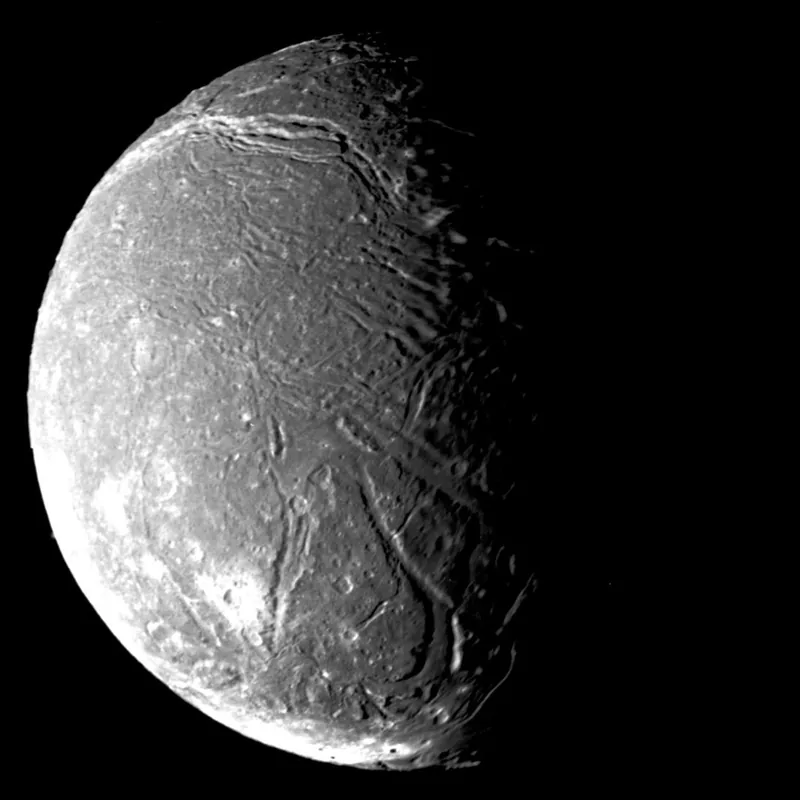
A mosaic of the four highest-resolution Voyager 2 images of Ariel, taken through the clear filter of the narrow-angle camera on 24 January 1986. The official caption calls this the most detailed Voyager 2 picture of the satellite. Public domain. Photo: NASA / JPL · Public domain · NASA/JPL / Wikimedia Commons 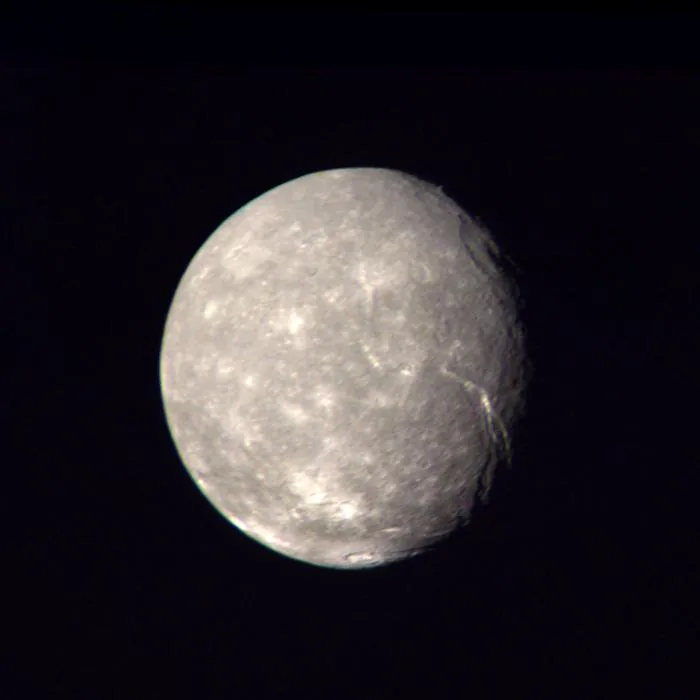
A high-resolution colour composite of Titania, made from Voyager 2 images taken on 24 January 1986 as the spacecraft neared its closest approach to Uranus. Public domain. Photo: NASA / JPL · Public domain · NASA/JPL / Wikimedia Commons 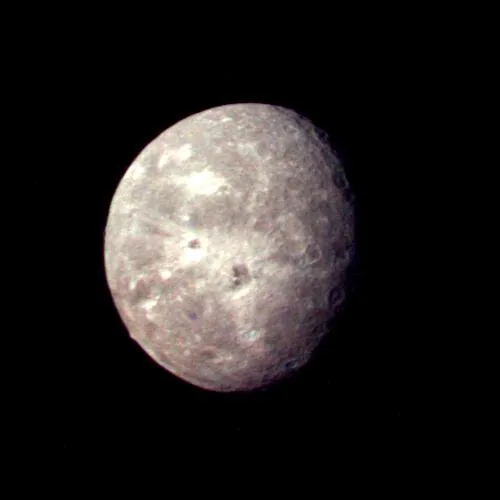
Voyager 2’s best picture of Oberon, Uranus’s outermost moon, taken shortly after 3:30 a.m. PST on 24 January 1986, from 660,000 kilometres (410,000 miles). The official caption notes that the colour was reconstructed. Public domain. Photo: NASA / JPL · Public domain · NASA/JPL / Wikimedia Commons 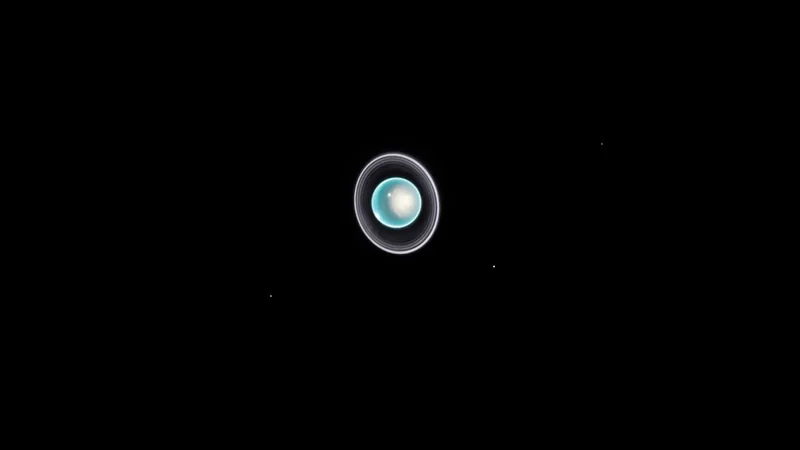
Uranus with Ariel, Miranda and Umbriel, processed from JWST NIRCam data by Andrea Luck, dated 7 August 2023. Credit: NASA/ESA/CSA/STScI/Andrea Luck, CC BY 2.0. A colourised derivative of official observatory data, credited as such, not as a raw NASA still. Photo: NASA/ESA/CSA/STScI / Andrea Luck · CC BY 2.0 · NASA/ESA/CSA/STScI / Andrea Luck / Wikimedia Commons
Enjoyed a 97.77-degree tilt, a 21-year winter, and a Voyager disk that is not the same as a Webb ring portrait?
No pop-ups. No intrusive advertising. Just interesting stuff. A little support helps the next planets.im site get built.