Field notes
Useless’s field notes
Official wording, kept distinct. A pale disk that needed its caption.
Useless has been comparing official pages, and reading Voyager captions twice.
30,685.400 days, and 30,687 Earth days
The fact sheet’s sidereal orbit and NASA Science’s public year are both official, and they are not the same number. [source] [source]
17.24 hours, and about 17 hours
The fact sheet’s length of day, and Science’s rounded public wording. The minus sign on −17.24 hours stays visible; it marks a retrograde spin.
58.6 degrees, and nearly 60 degrees; 0.352 Ru, and one-third of the radius
The fact sheet’s magnetic dipole tilt and offset, beside NASA Science’s rounded public wording. Same kind of figure, not silently merged.
0–250 m/s, and 560 miles per hour
250 m/s is 900 km/h, which is Science’s 560 miles per hour. This is the friendly kind of difference: units, not a quarrel.
49 K, 53 K, and 76 K
Science’s minimum of 49 K is not the same official figure as the fact sheet’s 53 K at 0.1 bar or 76 K at 1 bar. All three stay labelled.
Two Voyager disks, and a Science sentence about 1986
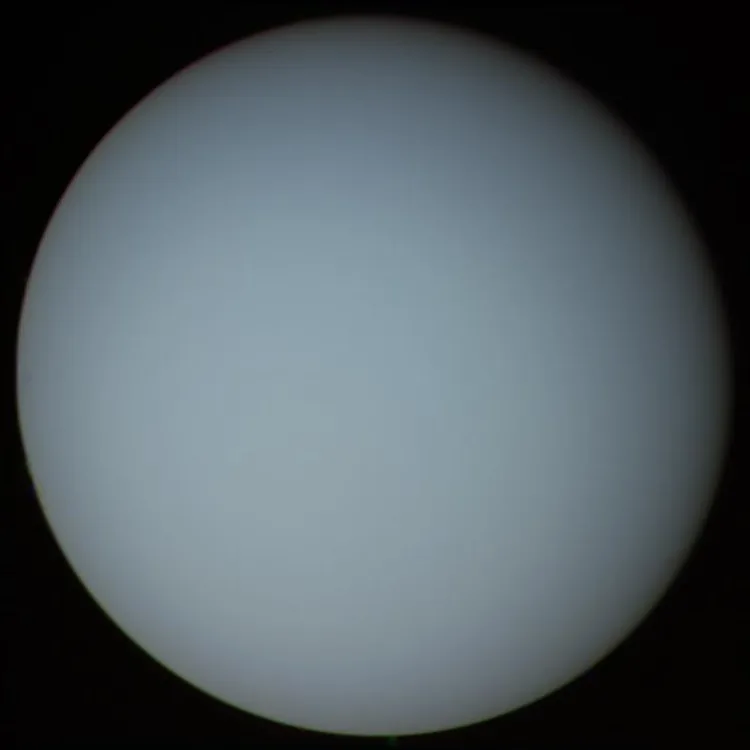
One official file is processed to show the planet as human eyes would see it. Another official file points you to that one for the visible-light appearance. NASA Science’s facts page has its own wording about clouds and dark spots during the flyby. This site quotes all three, and does not tidy them into a single memory of the encounter.
Enjoyed a 97.77-degree tilt, a 21-year winter, and a Voyager disk that is not the same as a Webb ring portrait?
No pop-ups. No intrusive advertising. Just interesting stuff. A little support helps the next planets.im site get built.