A short history
A telescope, a king’s name that did not stick, and one flyby
13 March 1781, Georgium Sidus, and then a two-year wait to be accepted as a planet. Voyager 2, in January 1986, remains the only spacecraft to have visited.
The fact sheet is brief: discoverer William Herschel, date 13 March 1781. [source] NASA Science tells the same date, and then the human part. Uranus was the first planet found with the aid of a telescope. Herschel originally thought it was either a comet or a star. It was two years later that the object was universally accepted as a new planet, in part because of observations by Johann Elert Bode. Herschel tried unsuccessfully to name his discovery Georgium Sidus after King George III. The planet was named for Uranus, the Greek god of the sky, as suggested by Bode. [source]
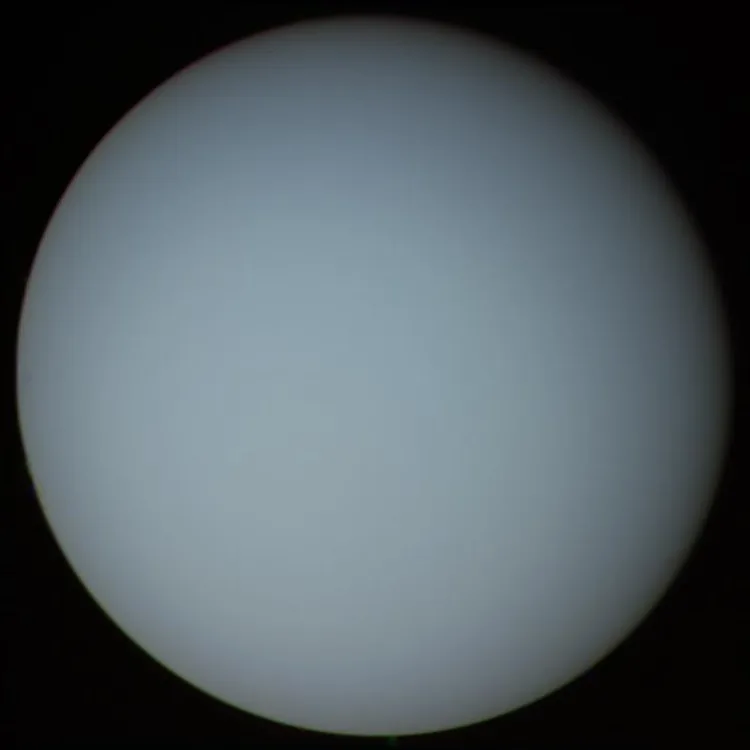
For the next two centuries the planet was a difficult disk in telescopes. Then, in January 1986, Voyager 2 flew by — still the only spacecraft to have done so, on NASA Science’s telling of a very cold and windy world. The visible-light composite from 17 January, several days out, is how the official caption says the eye would have seen it. The close mosaics of Miranda, Ariel, Titania and Oberon are from that same encounter, around 24 January.
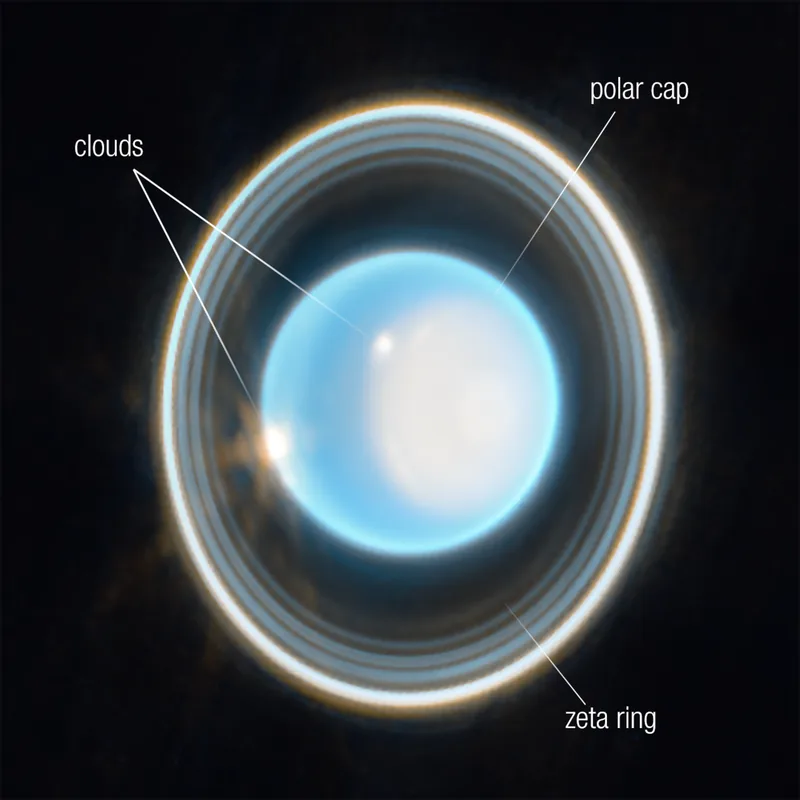
Hubble later added natural-colour rings and a measured dark spot. Webb, in April 2023, added an infrared portrait whose official caption is proud of the faintest dusty rings. The discovery story and the close-look story are two centuries apart, and they belong on the same site.
The sideways seasons Herschel could not have guessed are on the tilt desk.
Enjoyed a 97.77-degree tilt, a 21-year winter, and a Voyager disk that is not the same as a Webb ring portrait?
No pop-ups. No intrusive advertising. Just interesting stuff. A little support helps the next planets.im site get built.