Official figures
Facts, with the official wording left intact
The fact sheet is for tabulated figures. NASA Science is for the public wording. This list does not pick a winner when they differ.
Tabulated figures are from the NASA / NSSDCA Uranus Fact Sheet. [source] Public wording is from NASA Science’s Uranus facts page. [source] Where they differ, both are kept.
- Discovery
- Fact sheet and NASA Science: William Herschel, 13 March 1781. NASA Science: first planet found with a telescope; originally thought a comet or a star; almost named Georgium Sidus; named for the Greek god of the sky at Johann Bode’s suggestion.
- Mass, volume, radius
- Fact sheet: mass 86.811 × 1024 kg, ratio 14.54; volume ratio 63.08; equatorial radius (1 bar) 25,559 km, ratio 4.007; volumetric mean radius 25,362 km, ratio 3.981. NASA Science: equatorial diameter 31,763 miles (51,118 kilometres), four times wider than Earth.
- Density and gravity
- Fact sheet: mean density 1,270 kg/m3, ratio 0.230; mean gravity at 1 bar 9.01 m/s2 (Earth 9.82), ratio 0.918; escape velocity 21.3 km/s. NASA Science: the second least dense planet; Saturn is the least dense of all.
- Distance and year
- Fact sheet: semimajor axis 2,867.043 × 106 km, 19.191 AU; sidereal orbit 30,685.400 days, ratio 84.011; tropical orbit 30,588.740 days. NASA Science: 1.8 billion miles (2.9 billion kilometres), about 19 AU; light time 2 hours 40 minutes; about 84 Earth years (30,687 Earth days).
- Day and tilt
- Fact sheet: sidereal rotation −17.24 hours; length of day 17.24 hours; obliquity 97.77 degrees. NASA Science: about 17 hours; tilt 97.77 degrees; one of two planets with opposite rotation (Venus is the other); 21-year-long dark winters.
- Moons and rings
- Fact sheet: 28 natural satellites; rings yes. NASA Science: 28 known moons, named for Shakespeare and Pope; 13 faint rings (Zeta, 6, 5, 4, Alpha, Beta, Eta, Gamma, Delta, Lambda, Epsilon, Nu, Mu).
- Atmosphere
- Fact sheet: 82.5% H2, 15.2% He, 2.3% CH4; 76 K at 1 bar, 53 K at 0.1 bar; winds 0–250 m/s. NASA Science: mostly hydrogen and helium with a little methane; methane gives the blue-green colour; minimum temperature 49 K; winds up to 560 mph (900 km/h), retrograde at the equator.
- Magnetosphere
- Fact sheet: dipole tilt 58.6 degrees; offset 0.352 Ru; surface field ~0.1–1.0 Gauss. NASA Science: magnetic axis tilted nearly 60 degrees and offset by one-third of the planet’s radius; auroras not in line with the poles; magnetotail twisted into a corkscrew.
- Apparent magnitude
- Fact sheet: mean opposition 5.57; maximum 5.38.
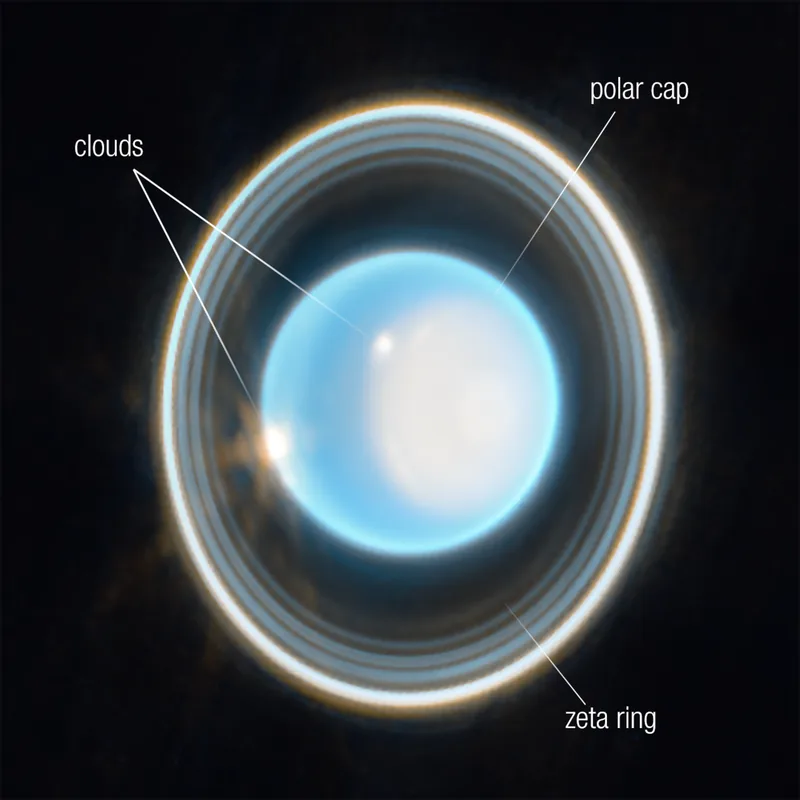
Enjoyed a 97.77-degree tilt, a 21-year winter, and a Voyager disk that is not the same as a Webb ring portrait?
No pop-ups. No intrusive advertising. Just interesting stuff. A little support helps the next planets.im site get built.