Signature desk
The planet on its side
A 97.77-degree tilt, agreed by two official pages; a 21-year-long dark winter, in NASA Science’s wording; and a year of 84 Earth years, told as 30,685.400 days and as 30,687.
The planet on its side
This is one of the rare desks where two official NASA pages say the same number out loud: 97.77 degrees. [source] [source] NASA Science adds the picture: Uranus is the only planet whose equator is nearly at a right angle to its orbit, so it appears to spin sideways, orbiting the Sun like a rolling ball. The fact sheet marks the spin itself as −17.24 hours, the minus sign meaning retrograde; the length of day is 17.24 hours. NASA Science says one day takes about 17 hours, and that Uranus is one of just two planets that rotate in the opposite direction than most — Venus is the other.
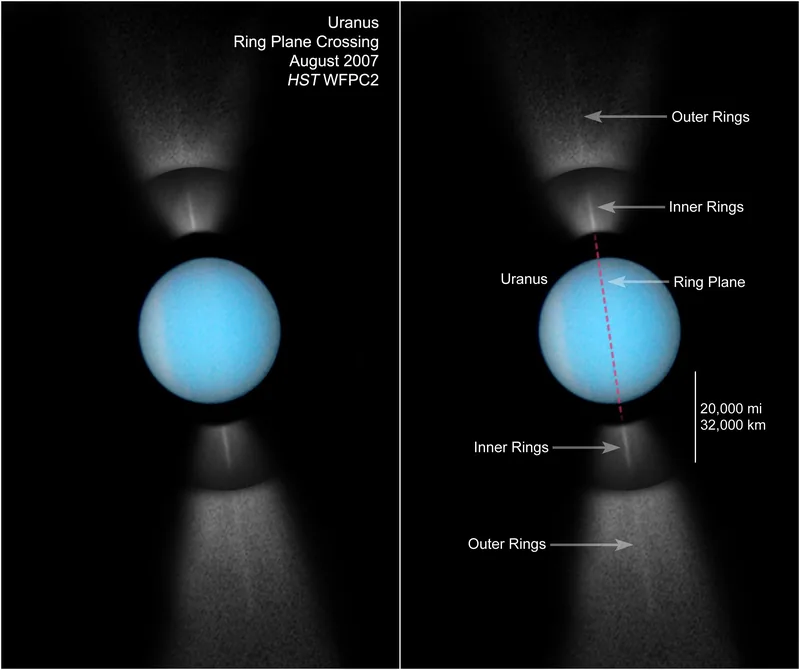
Hubble, on 14 August 2007, caught the rings edge-on to Earth — a sideways world presenting its rings as a line. NASA Science says the unique tilt causes the most extreme seasons in the solar system: for nearly a quarter of each Uranian year the Sun shines directly over each pole, plunging the other half into a 21-year-long, dark winter. [source] The page also says this tilt may be the result of a collision with an Earth-sized object long ago. That “may” stays a “may.”
The year is official twice, and not quite identical. The fact sheet’s sidereal orbit period is 30,685.400 days, or 84.011 Earth years. [source] NASA Science says about 84 Earth years (30,687 Earth days). [source] This desk keeps both counts. It does not average them into a third year.
The weather those long seasons rearrange is on the pale-disk page. The moons are on the moons page.
Enjoyed a 97.77-degree tilt, a 21-year winter, and a Voyager disk that is not the same as a Webb ring portrait?
No pop-ups. No intrusive advertising. Just interesting stuff. A little support helps the next planets.im site get built.