Myths versus facts
What the official pages actually say
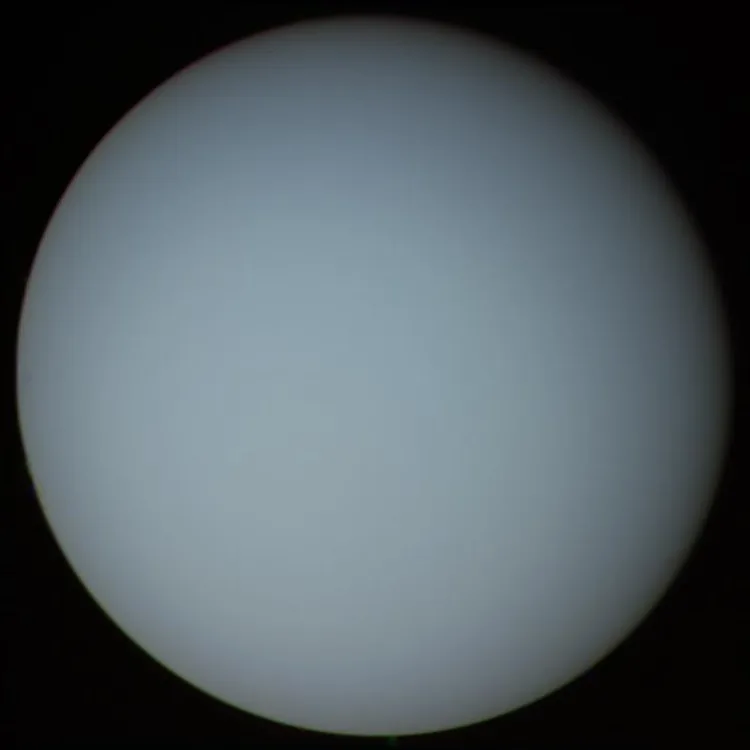
A pale disk is not a Webb ring portrait. 30,685.400 days is not 30,687. And Herschel wanted to name the planet after a king.
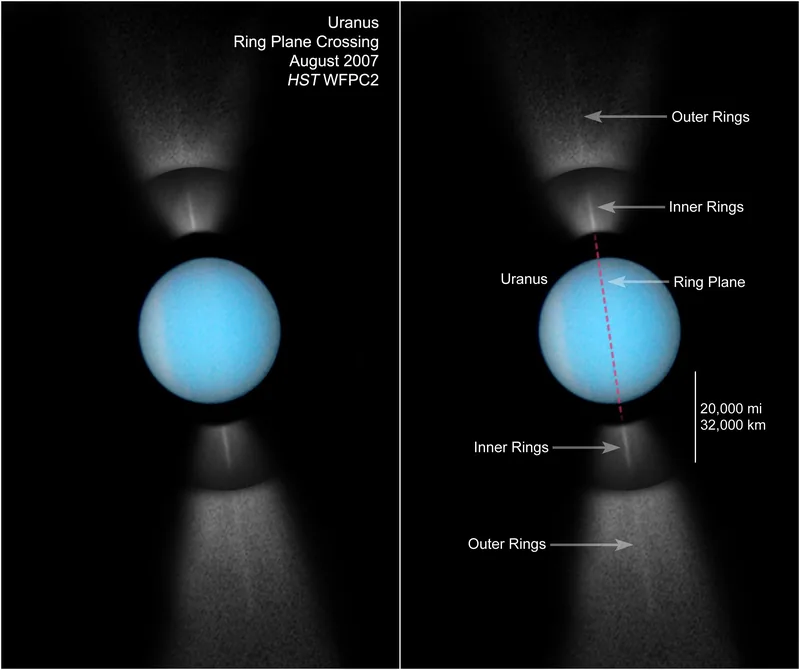
Myth: Voyager’s Uranus and Webb’s Uranus are the same kind of picture
The official visible-light Voyager composite is processed to show the planet as human eyes would see it, and it is pale. The Webb still is infrared, and is full of rings. A second Voyager file even points you back to the visible-light version. The labels matter.
Myth: the year is one agreed official number
The fact sheet’s sidereal orbit is 30,685.400 days, or 84.011 years. [source] NASA Science says about 84 Earth years (30,687 Earth days). [source] Close, official, and not silently merged.
Myth: Herschel named it Uranus on the spot
NASA Science says he tried to name it Georgium Sidus after King George III, and that the Greek name was Bode’s suggestion. The discovery date, 13 March 1781, is not in dispute.
Myth: a 97.77-degree tilt is a rounded ‘about 90’
Both official pages give 97.77 degrees. NASA Science’s ‘nearly 90-degree angle’ and ‘right angle’ are public wording for the same official tilt, and they sit beside the number, not instead of it.
Enjoyed a 97.77-degree tilt, a 21-year winter, and a Voyager disk that is not the same as a Webb ring portrait?
No pop-ups. No intrusive advertising. Just interesting stuff. A little support helps the next planets.im site get built.