Questions
Questions people actually ask
Short answers, from official pages and file captions, with the rounding left visible.
Why does Uranus look sideways?
Both official pages give a tilt of 97.77 degrees. NASA Science says that makes it appear to spin sideways, orbiting like a rolling ball, and may be the result of a collision with an Earth-sized object long ago. [source]
How long is a year on Uranus?
The fact sheet: 30,685.400 days, or 84.011 Earth years. [source] NASA Science: about 84 Earth years (30,687 Earth days). [source]
How long is a day?
Fact sheet: length of day 17.24 hours, sidereal rotation −17.24 hours (retrograde). [source] NASA Science: about 17 hours, and one of two planets that rotate in the opposite direction (Venus is the other). [source]
How many moons does Uranus have?
28, on both the fact sheet and NASA Science. NASA Science adds that they are named for characters from Shakespeare and Alexander Pope.
Who discovered Uranus, and when?
William Herschel, on 13 March 1781, on both official pages. NASA Science says it was the first planet found with a telescope.
Did Voyager 2 see a blank planet?
The official visible-light composite is processed to show Uranus as human eyes would see it, and it is very pale. NASA Science’s facts page has its own wording about discrete clouds and dark spots in 1986. Both official accounts stay on the weather page.
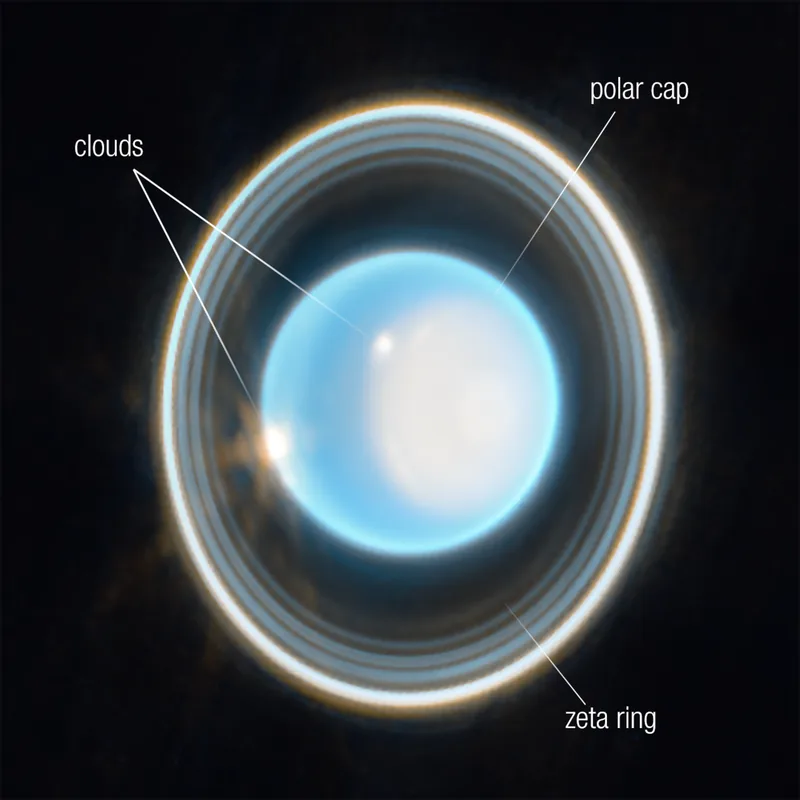
Enjoyed a 97.77-degree tilt, a 21-year winter, and a Voyager disk that is not the same as a Webb ring portrait?
No pop-ups. No intrusive advertising. Just interesting stuff. A little support helps the next planets.im site get built.